
當審稿人意見打架、編輯才是裁決者:進階回覆信的協商策略
從衝突意見的仲裁、回覆信的資訊架構,到第二輪與申訴的賽局——把回覆信寫成一份說服編輯的協商文件。
當兩位審稿人要你往相反方向改,你聽誰的?
你已經知道怎麼讀懂決定信、怎麼用 point-by-point 格式逐條禮貌回應。現在來談一個入門篇刻意略過、但每一篇 major revision 幾乎都會撞上的難題:Reviewer 1 要你把第四節砍掉,Reviewer 2 卻要你把第四節擴寫成兩倍。 兩條意見都很合理,方向卻完全相反。你照其中一個改,另一個下一輪一定不滿;你兩邊各讓一半,可能兩邊都不滿。
這時候你需要的不是更有禮貌的句型,而是一套策略:把回覆信當成一份呈給編輯(editor)的協商文件來經營。進階的審稿回覆,重點已經不在「我怎麼把這條答得體面」,而在「我怎麼編排整封信,讓編輯在十分鐘內相信這篇稿子值得接受」。這篇文章談五件入門篇沒細講的事:對沖型決定信的真實機率、衝突意見的仲裁、回覆信的資訊架構、第二輪與申訴(appeal)的賽局,以及把編輯而非審稿人當成真正讀者的視角轉換。
編輯才是你的真正讀者:誰握有裁決權
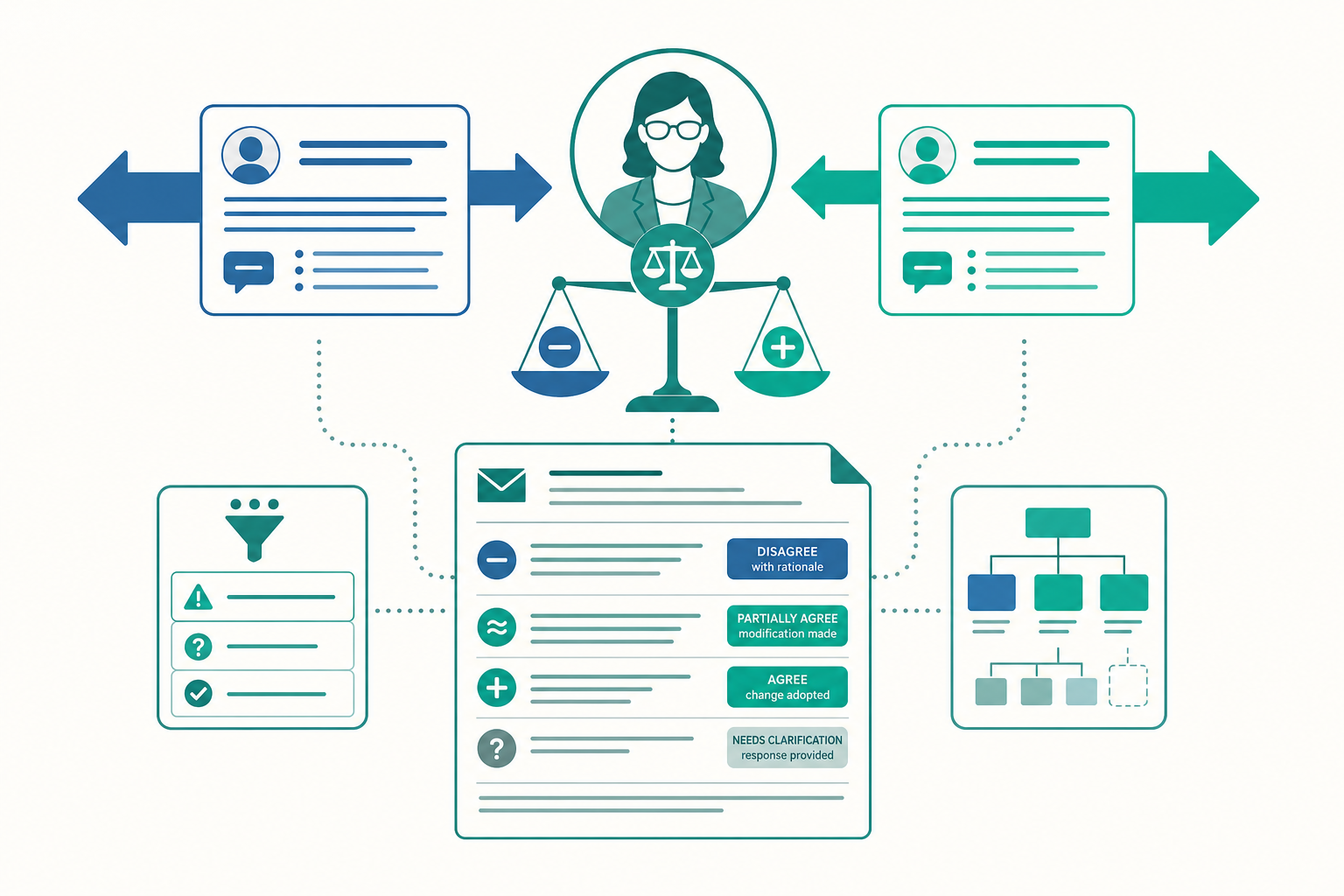
入門篇說「逐條回應讓審稿人重看時毫不費力」。沒錯,但要更進一步:審稿人提供意見,編輯做決定。 審稿人寫的是 recommendation(建議),不是 verdict(判決)。最終是否接受,是編輯綜合所有意見、加上他對期刊定位與稿件潛力的判斷後拍板。
這個權力結構改變了你的寫作目標。你回覆的表面對象是審稿人,真正要說服的對象是編輯。編輯通常很忙,他不會逐句重讀你的論文,他讀的是:(1) 你的 cover letter 或回覆信開頭那段摘要,(2) 哪幾條意見被「漂亮地解決了」,(3) 哪幾條你「頂回去了、頂得有沒有道理」。
所以進階回覆信會在開頭放一段給編輯的導讀(editor-facing summary),而不只是泛泛感謝。對照一下。
❌ 入門級開頭(只感謝、無導航):
We thank the editor and the two reviewers for their valuable comments. We have revised the manuscript accordingly. Our point-by-point responses are below.
✅ 進階開頭(給編輯一張地圖):
We thank the editor and both reviewers for their constructive feedback. The revision addresses three substantive issues: (1) we have added inter-rater reliability statistics and re-analysed the data with a mixed-effects model (Reviewer 1, Comments 1–3); (2) we have substantially expanded the discussion of generalisability (Reviewer 2, Comment 4); and (3) on one point — the proposed removal of Section 4 — the two reviewers offered opposing recommendations, which we discuss explicitly below and resolve by restructuring rather than deleting. All changes are marked in blue in the revised manuscript.
第二版做了三件事:把分散的意見歸併成三個主題、用括號標出對應哪幾條、並主動點名那個衝突點告訴編輯「我有意識到、我有處理」。編輯讀完這一段,心裡已經有了「這作者很上道」的印象——而這個第一印象會滲透他讀後面每一條回應時的判斷。
衝突意見的仲裁:不選邊,向上呈報
回到開頭那個兩位審稿人方向相反的難題。新手的直覺是「選一個聽」,但這往往是錯的。衝突意見要當成你向編輯陳情的契機,而不是二選一的陷阱。
處理衝突意見有三個層次,由弱到強。
層次一:找出衝突底下的共識。 兩位審稿人表面要求相反,深層關切常常一致。Reviewer 1 要砍第四節,可能是覺得它離題、拖慢節奏;Reviewer 2 要擴寫,可能是覺得它論證不足、撐不起結論。兩人其實都在說「第四節現在這樣不行」。你的解法可以是:重構而非加減——把第四節聚焦到與主論點直接相關的部分(回應 R1 的離題疑慮),同時把保留下來的部分論證做紮實(回應 R2 的不足疑慮)。
層次二:把權衡攤開給編輯看。 當無法兩全時,明說你的取捨依據,並把裁量權交還編輯。
On the conflicting recommendations regarding Section 4: Reviewer 1 suggested removing Section 4 as a digression, whereas Reviewer 2 recommended expanding it. We have weighed both views. Because Section 4 provides the empirical grounding for our central claim in Section 5, we judged that outright removal would weaken the argument; however, we agree with Reviewer 1 that the original version was overly long. We have therefore condensed it from 1,200 to 700 words, retaining only the analysis that directly supports Section 5, and added the two clarifying paragraphs Reviewer 2 requested. We would of course be glad to follow the editor's guidance should a different balance be preferred.
這段話的關鍵句是最後一句:We would be glad to follow the editor's guidance should a different balance be preferred.——它把最終決定權禮貌地、明確地還給握有裁決權的人。編輯讀到這裡會感覺被尊重,也更傾向支持你的折衷方案。
層次三:絕不挑撥審稿人互鬥。 千萬別寫 As Reviewer 2 correctly noted, Reviewer 1's suggestion would harm the paper.——拿一位審稿人去打另一位,會讓編輯覺得你在操弄、不夠成熟。你可以引用兩人的共識,但語氣永遠是「我綜合了兩位的洞見」,而非「我選了比較聰明的那位」。
回覆信的資訊架構:讓「已解決」一眼可見
入門篇給了 Comment / Response / Change in manuscript 三段式。進階要談的是整封信的資訊架構(information architecture)——當你有 30 條意見時,怎麼編排才不會讓編輯讀到第 12 條就累了。
幾個可操作的進階技巧:
一、用「狀態標籤」開頭,給每條回應一個一秒可辨識的結論。 在每條 Response 第一句用一個明確的動詞短語宣告你做了什麼,編輯掃過去就知道這條是「改了」「釐清了」還是「禮貌不同意」。
❌ 不佳(埋在段落中間,要讀完才知道結論):
Response: This is an interesting question. There are several considerations here. The variable in question was measured using a standard scale, and after thinking about it, we decided to add a robustness check, which can now be found in the appendix.
✅ 改良(首句即結論):
Response: Addressed by adding a robustness check (Appendix C). We agree this concern warranted verification. We re-ran the analysis excluding the outlier cases; the main effect remained significant (p = .003), confirming the result is not driven by extreme values.
二、把瑣碎意見「打包」處理,別讓它們稀釋重點。 審稿人常混雜重大方法質疑與一堆錯字、格式建議。不要平均用力。重大意見展開回應,瑣碎意見可以集中成一段。
Minor comments (Reviewer 2, items 7–14): We have corrected all the typographical and formatting issues noted (items 7, 9, 11–14), updated the citation style as requested (item 8), and clarified the axis labels in Figure 3 (item 10). We are grateful for this careful reading.
這樣處理,編輯不會被八條小事淹沒,注意力留給真正重要的回應。
三、量化你的修改幅度。 模糊的「we have substantially revised」沒有說服力,具體數字才有。「we added 14 new references」「we collected an additional 60 participants」「the discussion grew from two to four paragraphs」——數字讓編輯感受到你的誠意是真金白銀。
看一個例子:把一條「我其實不同意」的意見答得讓編輯站你這邊
假設審稿人寫:"The effect size is small. I doubt this finding has any practical significance." 你做過功課,知道在你的領域這個效果量其實是有意義的,但你不能只說「審稿人不懂」。
❌ 防衛版(即使有理也輸):
The reviewer underestimates the importance of this effect. Small effects are common and important in our field.
✅ 進階版(承認、給證據、量化、把判斷權給編輯):
Reviewer 1, Comment 5: "The effect size is small. I doubt this finding has any practical significance."
Response: Clarified with field benchmarks; no change to the analysis. We thank the reviewer for prompting us to justify the practical relevance of our effect. We would respectfully note that in educational intervention research, effect sizes of this magnitude (d ≈ 0.25) are both common and consequential: Hattie's (2009) synthesis treats d = 0.20 as the threshold of a noticeable educational effect, and Kraft (2020) argues that effects above 0.20 are policy-relevant when an intervention is low-cost and scalable, as ours is. To make this explicit, we have added two sentences to the Discussion (page 13, lines 350–356) situating our effect against these benchmarks, and we now report the cost-per-student to underscore scalability. We defer to the editor's judgement on whether further emphasis is warranted.
分析這版做對了什麼:它沒有否定審稿人,而是把爭點從「主觀感覺」抬升到「領域公認的量化標準」(引用了具體文獻與閾值);它承認自己原稿沒講清楚(所以補了兩句);它把判斷權交還編輯。當你用社群共享的證據標準說話,編輯幾乎一定站在「有引用、有數據」的那一方。
第二輪與申訴:被退稿之後的賽局
入門篇止於「寫好第一封回覆信」。但真實發表常常是多輪的,進階作者必須懂第二輪(second round)與申訴(appeal)的潛規則。
第二輪的鐵律:別製造新的戰場。 第一輪你改了一堆,第二輪審稿人可能對你的修改又提出新意見。這時最危險的心態是「趁機把上一輪沒講的也順手改了」。每一個你主動引入的新變動,都是一個新的可被攻擊面。第二輪的目標是收斂,不是擴張。回應第二輪時,明確區分「這是回應您本輪意見的修改」與「除此之外全文未動」:
In this second revision we have made only the changes requested in the latest round; no other part of the manuscript has been altered. The specific revisions are as follows...
這句話本身就在安撫審稿人:你不必重讀全文,只要檢查這幾處。
當審稿人在第二輪推翻第一輪自己說過的話——這比你想的常見。禮貌但清楚地提醒,並把裁量交給編輯:
We note that this point relates to a passage we added in direct response to the reviewer's first-round Comment 2. To reconcile both rounds of feedback, we have... We would welcome the editor's guidance if a different approach is preferred.
申訴(appeal)是一張只能打一次的牌。 如果你確信編輯誤判、或審稿人有明確事實錯誤(而非只是品味不同),你可以寫信給編輯申訴。但申訴的成功率不高,且只有在你能指出客觀錯誤時才值得用。
❌ 不該申訴的理由(純主觀不滿):
We strongly disagree with the rejection. We believe our paper is novel and the reviewers were too harsh.
✅ 值得申訴的理由(指出客觀事實錯誤):
We respectfully request reconsideration on one specific ground. Reviewer 2's central objection — that we failed to control for prior achievement — appears to rest on a misreading: prior achievement was in fact included as a covariate (Table 2, Model 3, page 9). We suspect this may have been overlooked. We do not contest the editor's overall judgement, but as this single point was described as decisive, we felt it important to clarify.
注意語氣:申訴信要極度克制,只攻一個可驗證的點,明說「我不挑戰整體判斷,只澄清這個關鍵事實」。把申訴範圍縮到最小,是它唯一可能成功的方式。
動手試試:替三種棘手情境各擬一句策略性回應
不必寫完整段落,先抓住「策略動作」。
- 兩位審稿人對你的理論框架評價相反:一位說「框架很有啟發」,一位說「框架是多餘的包裝」。你的開頭句該怎麼向編輯定調?
- 審稿人要求補一個你做不到的實驗,但語氣是 dealbreaker:你要既守住底線、又不顯得在逃避。
- 第二輪審稿人對你第一輪新增的段落不滿:你要提醒這段是「應上一輪要求而加」,又不能顯得在甩鍋。
參考方向(句型骨架,非標準答案):
- The two reviewers offered divergent assessments of our theoretical framing. Rather than choosing between them, we have clarified the specific work the framework does in our analysis, so that its contribution is judged on function rather than impression (see Section 2.2). ——把「喜不喜歡」轉成「它有沒有用」,是化解品味之爭的常見手法。
- We fully agree that the proposed experiment would provide the most direct test. As it requires equipment unavailable to our team, we have instead provided the strongest feasible alternative — a re-analysis using [method] — and have explicitly flagged the direct experiment as the key next step (Section 6). ——
strongest feasible alternative是黃金片語:承認最佳解、給出次佳解。 - This paragraph was added in direct response to Reviewer 1's first-round request for more detail on X. To address the present concern while honouring that earlier request, we have [tightened / relocated] it rather than removed it. ——同時致敬兩輪意見,姿態是「協調」不是「甩鍋」。
重點回顧
- 編輯才是裁決者:審稿人給 recommendation,編輯做 decision。回覆信開頭放一段給編輯的「導讀地圖」,把分散意見歸併成幾個主題並點名衝突點。
- 衝突意見不選邊:先找兩位審稿人底下的共識(常常是同一個問題),用重構而非加減去同時回應;無法兩全時攤開取捨、把裁量權交還編輯,絕不挑撥審稿人互鬥。
- 資訊架構決定說服力:每條回應首句用狀態標籤(Addressed / Clarified / Respectfully disagree)宣告結論;瑣碎意見打包;用具體數字量化修改幅度。
- 爭點要抬升到社群標準:不同意時引用領域公認的量化閾值與文獻,把「主觀感覺之爭」變成「有沒有證據之爭」,編輯自然站在有數據的一方。
- 第二輪求收斂、申訴極克制:第二輪別引入新戰場、明說「其餘未動」;申訴只在能指出客觀事實錯誤時動用,且把範圍縮到單一可驗證點。
深入探討(研究所視角)
入門篇從學術社群學談 gatekeeping 與 ethos。進階一層,我們把回覆信放進賽局論(game theory)與機制設計(mechanism design)的框架,看清你在這個系統裡到底在玩什麼樣的局。
第一,這是一個資訊不對稱的多方賽局,而你能影響的是「審查成本」。 審稿是無償勞動,審稿人的時間極度有限。從機制設計的角度,整套同儕審查制度依賴志願者的善意供給,而這種供給對「處理一篇稿件要花的力氣」極度敏感。你前面學的所有技巧——導讀地圖、狀態標籤、打包瑣碎意見、量化修改——本質上都是在降低編輯與審稿人的認知成本(cognitive load)。這不只是禮貌,而是賽局中的理性策略:當你把對方的工作變輕,你就提高了「接受」相對於「再要一輪」的相對效用。Squazzoni 等人對審查經濟學的研究指出,審查系統的瓶頸從來不是稿件品質,而是合格審稿人的稀缺與疲勞;懂得體恤這個稀缺的作者,在重複賽局裡會累積聲譽紅利。
第二,回覆信是一場關於「可信承諾(credible commitment)」的訊號賽局。 借用 Spence 的訊號理論(signaling theory),審稿人無法直接觀察你「是不是一個嚴謹、可被說服、會誠實面對資料的研究者」,他只能從你的回覆推斷。一封充滿具體頁碼行號、量化數字、引用閾值的回覆,是一個昂貴而難以偽造的訊號(costly signal)——只有真的做了功課的人才寫得出來。反之,空泛的 we have substantially revised 是廉價訊號,誰都能寫,因此不被採信。這解釋了為什麼「具體」在審稿回覆裡有近乎神奇的說服力:它不只傳遞資訊,它證明了你付出的成本,從而讓你的承諾變得可信。
第三,從衝突意見看審查信度(reliability)的結構性限制與你的因應位置。 審稿人之間的一致性(inter-reviewer agreement)在許多研究中低得驚人——以 Cohen's κ 衡量常落在 0.2–0.4 的「微弱一致」區間。這不是個別審稿人的失職,而是學術判斷本身具有不可化約的主觀成分(價值多元、典範差異)。理解這點會改變你面對衝突意見的心態:衝突不是「有人錯了」,而是制度的常態輸出。你的位置不是去消弭主觀性,而是在主觀性的縫隙中為編輯提供一個可辯護的折衷敘事。這也呼應了 Bayesian 的視角——編輯在綜合多個帶噪訊號(noisy signals)後更新信念,你的回覆信就是試圖往有利方向提供一個高品質、低噪音的額外訊號。
延伸方向:當前的制度正在變化。開放同儕審查(open peer review)與已發表審查報告(published review reports,如 eLife 的 reviewed preprint 模式)讓回覆信本身成為公開學術紀錄,這把「述行語言」的賭注抬高——你的回覆是寫給整個社群、且永久留存的。同時,AI 輔助回覆草擬正在快速普及:大型語言模型能極有效率地把你的論點包裝成得體的學術句型、補齊 hedging 標記、甚至模擬審稿人視角預測反駁。這在策略層面是強大的助力,但也製造了新的訊號失真風險——當「昂貴訊號」變得廉價可生成,社群勢必發展出新的可信度判準(例如更看重可驗證的具體事實、原始資料與可重現性)。對研究者而言,工具可以替你磨語氣、編架構,但對證據負責、對科學主張誠實、對審稿人的勞動心存敬意這三件事,無法外包,也正是你在這個長期重複賽局裡最終的聲譽資產。