
寫一章別人複製得出來的方法:學術英文方法章的可重現性
從「我做了什麼」升級到「別人也能做」,把模糊敘事改寫成可操作的研究規格
為什麼你的方法章讀起來像「我做了什麼」,而不是「別人也能做」
想像一位審稿人翻開你的論文方法章(Methods),讀到這一句:
"We collected some data from students and analyzed it using statistics."
他皺起眉頭。多少學生?哪間學校?什麼時候收的?「some data」是訪談、問卷、還是學習歷程記錄?「statistics」是 t 檢定還是迴歸?這段話什麼都沒說,卻佔了一行字數。
方法章的唯一使命,是讓一位素未謀面的同行,光靠你寫下的文字,就能在他自己的實驗室、他自己的班級、他自己的資料集上,重新走一遍你走過的路。這就是「可重現性」(reproducibility)。如果別人讀完還是不知道怎麼複製你的研究,那這一章就失敗了——無論你的實驗做得多漂亮。
換句話說,方法章不是寫給你自己看的日記,而是寫給未來那位想驗證、想延伸、想挑戰你的研究者看的「操作手冊」。
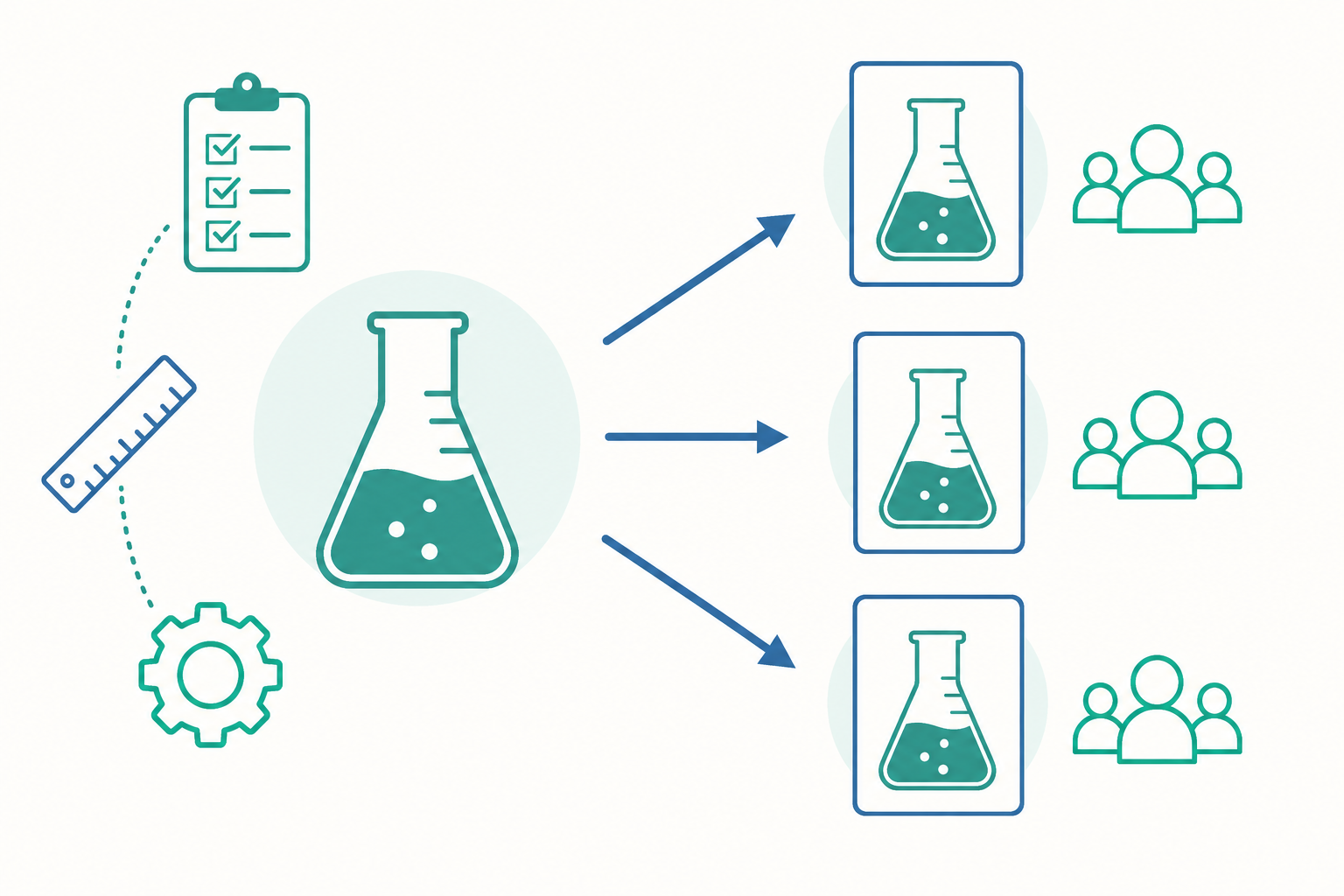
方法章的黃金準則:具體、可操作、可複製
新手最常見的迷思,是把方法章寫成「一篇敘事」——按時間順序流水帳式地交代「我先做了 A,再做了 B」。但審稿人要的不是故事,而是規格(specification)。
判斷一句方法章寫得好不好,只要問一個問題:「讀者能照著做嗎?」
來看一組對照:
不佳:
"A questionnaire was given to participants to measure their motivation."
改良:
"Participants completed the 7-item Intrinsic Motivation Inventory (IMI; Ryan, 1982), rated on a 5-point Likert scale (1 = strongly disagree, 5 = strongly agree). The Chinese version was back-translated by two bilingual researchers."
改良版交代了工具來源(IMI,附引用)、題數(7 題)、量尺(5 點 Likert,且說明端點)、以及翻譯程序(回譯)。每一個細節都是別人複製時必須知道的參數。前者只是一句空話。
再看一組:
不佳:
"We used AI to help students learn."
改良:
"Students interacted with a custom GPT-4o-based teaching assistant (temperature = 0.7) embedded in the Uedu platform. The system prompt instructed the assistant to use Socratic questioning rather than providing direct answers."
「used AI」是 2026 年最沒有資訊量的一句話。改良版指明了模型版本(GPT-4o)、關鍵參數(temperature)、部署環境(Uedu)、以及行為設定(蘇格拉底式提問)。沒有這些,別人根本無法重現你的「AI」到底是什麼。
時態與語態:方法章的語法慣例
方法章有兩個牢固的語法慣例,值得你刻進肌肉記憶。
第一,已完成的動作用過去式(past tense)。 因為你描述的是一個已經發生、已經結束的研究程序。
不佳:
"We recruit 120 students and ask them to complete the test."(現在式,像是還在進行)
改良:
"We recruited 120 students and asked them to complete the test."
第二,被動語態(passive voice)在方法章是合法且常見的,因為讀者關心的是「做了什麼」而非「誰做的」。不過近年期刊(尤其 APA 第七版)也鼓勵適度主動語態以增加可讀性。原則是:強調操作流程時用被動,強調研究者決策時用主動。
被動(強調程序):
"Audio recordings were transcribed using OpenAI Whisper and manually verified."
主動(強調決策):
"We excluded three participants who failed the attention check."
兩者都對。真正要避免的是為了顯得客觀而把每一句都寫成被動,造成句子冗長、動作者消失、責任歸屬模糊:
不佳(過度被動):
"It was decided that the data that had been collected would be analyzed in a manner that had been determined in advance."
改良:
"We analyzed the data using a pre-registered plan."
結構:方法章的標準骨架
大多數量化研究的方法章遵循一個可預測的子標題結構。即使你的領域略有差異,這個骨架能確保你不漏掉任何審稿人預期看到的資訊:
- 研究設計(Research Design):實驗 vs. 準實驗、橫斷 vs. 縱貫、組別配置。
- 參與者(Participants):人數、來源、人口統計、招募與排除標準、倫理審查。
- 材料/工具(Materials / Instruments):量表、設備、軟體、刺激物,附信效度。
- 程序(Procedure):從頭到尾,受試者經歷了什麼,按時序但寫成規格。
- 資料分析(Data Analysis):用了哪些統計方法、軟體版本、顯著水準。
每一節都要回答對應的「複製問題」。例如「參與者」一節,審稿人心裡的問題是:「我若要找一群跟你一樣的受試者,該去哪裡、找多少人、排除哪些人?」
不佳(參與者描述太空):
"The participants were university students."
改良:
"Participants were 142 undergraduate students (87 female, 55 male; M_age = 20.3, SD = 1.4) recruited from two general-education courses at a public university in Taiwan. Three students who completed less than 80% of the tasks were excluded, yielding a final sample of 139."
改良版讓任何人都能評估你的樣本是否具代表性、是否足以支撐你的結論。
寫「程序」時,把時間軸轉成規格
「程序」(Procedure)這一節最容易退化成流水帳。技巧是:保留時序,但每一步都寫成「可被執行的指令」,並交代每一步的參數(時長、次數、間隔)。
不佳:
"First the students did a pretest, then they used the system for a while, and finally they did a posttest and we interviewed some of them."
改良:
"The study comprised three phases over four weeks. In Week 1, students completed a 30-minute pretest. During Weeks 2–3, students used the Uedu ClassroomGPT assistant for at least two 50-minute sessions per week, logged automatically by the platform. In Week 4, students completed an equivalent posttest, and a purposive sample of 12 students participated in 20–30 minute semi-structured interviews."
注意改良版怎麼把「a while」變成「two 50-minute sessions per week」、把「some of them」變成「a purposive sample of 12 students」。所有模糊的量詞都被替換成具體數字。
看一個例子:把一段口語化方法描述改寫成可發表的版本
假設一位學生最初寫下:
"We made a chatbot and let students chat with it. We checked if they learned better. We compared the scores."
我們一步步診斷它缺了什麼:「made a chatbot」——什麼模型?「let students chat」——多久?多少人?有對照組嗎?「checked if they learned better」——用什麼測量?「compared the scores」——什麼統計?
改寫後:
"We developed a retrieval-augmented chatbot built on GPT-4o, grounded in course materials via a vector database. In a quasi-experimental design, two intact classes (n = 68) were assigned to either the chatbot-supported condition or a textbook-only control. Both groups studied the same content for three weeks. Learning gains were measured by a 20-item criterion-referenced test administered before and after the intervention. We compared normalized gain scores between conditions using an independent-samples t-test (α = .05), with Cohen's d reported as the effect size."
從 3 句空話,變成一段任何研究者都能評估、能複製的規格。這就是方法章寫作的核心功夫。
別把「結果」偷渡進方法章
一個常見錯誤是在方法章裡寫出數據結果。方法章只描述「你打算怎麼做」與「你實際做了什麼操作」,不報告做出來的數值。
不佳(混入結果):
"We administered the survey, and the average motivation score was 4.2, which was higher than the control group."
改良(只留方法):
"We administered the IMI motivation survey to both groups at the end of the intervention. Group differences were tested using an independent-samples t-test."
那個 4.2 應該出現在「結果」(Results)章,不是方法章。方法章是「食譜」,結果章才是「成品照片」。
動手試試:用「複製檢核表」自評你的方法章
寫完初稿後,逐項打勾,任何一項打不了勾,就回去補:
- [ ] 別人能從我的描述算出確切樣本數與排除流程嗎?
- [ ] 每個量表/工具都有引用或完整描述(題數、量尺)嗎?
- [ ] 所有軟體/模型都標了版本與關鍵參數嗎?
- [ ] 程序的每一步都有時長/次數嗎?
- [ ] 我有交代倫理審查(IRB 核准文號、知情同意)嗎?
- [ ] 我有避免把結果數字寫進來嗎?
- [ ] 統計方法有標軟體、版本、顯著水準嗎?
最後一項常被忽略:
不佳:
"Data were analyzed statistically."
改良:
"Data were analyzed in R (version 4.3.1) using the lme4 package. We fitted a linear mixed-effects model with student as a random intercept. Statistical significance was set at α = .05."
重點回顧
- 方法章的標準是「可複製」,不是「我做了什麼」的敘事。判準只有一句:別人照著做得出來嗎?
- 把模糊量詞換成具體數字:「some students」→「139 students」、「for a while」→「two 50-minute sessions per week」。
- 時態用過去式,語態被動主動並用:描述程序可被動,強調研究者決策用主動,但別過度被動造成冗長。
- 遵循標準骨架:設計 → 參與者 → 材料 → 程序 → 分析,每節回答對應的「複製問題」。
- 別把結果偷渡進方法章:方法章是食譜,數值結果留給結果章。
深入探討(研究所視角)
到了研究所層級,「可重現性」會從一個寫作技巧,升級為一套方法論的政治與哲學。
第一,可重現性危機(the reproducibility crisis)。 自 2010 年代心理學、醫學等領域的大規模重製失敗(如 Open Science Collaboration, 2015 在《Science》發表,僅約 36% 的心理學研究能成功重製)以來,期刊與審稿標準急遽提高。這直接改變了方法章的寫法:今天頂尖期刊期待你預先註冊(pre-registration)研究假設與分析計畫,並在方法章明確區分驗證性分析(confirmatory)與探索性分析(exploratory)。前者是你事前就決定要做的,後者是看到資料後才想到的——若把後者偽裝成前者,就是所謂的 HARKing(Hypothesizing After Results are Known)與 p-hacking,是當代研究倫理的紅線。你的方法章寫法,本身就是一份對抗這些偏誤的承諾。
第二,「方法」與「可複製性」的層級。 學界區分三個遞進概念: - Reproducibility(再現):用你的原始資料與程式碼,能得出相同結果。 - Replicability(複製):用新資料、相同方法,能得出一致結論。 - Generalizability(推廣):方法與結論能延伸到不同情境、母體。
一個寫得好的方法章,至少要保障第一層(提供資料與分析腳本的可得性聲明,data/code availability statement),並為第二層鋪路(細到別人能用新樣本重跑)。
第三,跨領域的張力——質性研究怎麼辦? 上述準則偏向量化典範。質性研究(訪談、民族誌、紮根理論)不追求「複製出相同數字」,而追求可信賴性(trustworthiness)(Lincoln & Guba, 1985):可信度(credibility)、可遷移性(transferability)、可靠性(dependability)、可確認性(confirmability)。因此質性方法章的「可重現」轉化為透明的審計軌跡(audit trail)——你如何編碼、如何達成編碼者間信度(inter-rater reliability,如 Cohen's κ)、如何反身性地檢視自己的研究者立場(positionality)。寫作目標從「讓人複製出相同結果」變成「讓人理解並信任你詮釋的歷程」。
第四,與本平台研究的連結。 在 Uedu 這類教育科技平台上做研究,方法章還要承擔一個額外責任:多模態資料的倫理透明度。當你的「材料」包含學習者的生理數據(HRV、睡眠)、對話軌跡、環境感測時,方法章必須交代資料收集的知情同意機制、去識別化程序與IRB 核准範圍。這正是 Educational Omics 框架中 Ethicomics 維度的具體落實——方法的「可重現」不只是技術問題,更是「在合乎研究倫理的前提下可重現」的承諾。一個未說明同意流程就大量蒐集生理數據的方法章,即使技術細節再完整,也不會被當代審稿人接受。
掌握這些,你的方法章就不再只是論文的一個段落,而是你作為研究者誠信與嚴謹的公開宣示。